Wednesday, April 2, 2014
Classification of burns...........
Doc, are there different ways to
classify burns?
Mrs. Janice Parker. S. Africa.
Yes there are different ways to
classify burns, but the whole purpose is to help in managing them in a better
way. Every burn must be mentioned by its
degree or depth since it lets the surgeon know whether he should manage the
patient conservatively or by surgery. Further classifying burns in major, minor
or moderate helps to decide the level of management that they need. Thus a
third degree burn even if it is one percent TBSA (total burn surface area) cannot be managed
conservatively and will need surgery. Again a 5 percent TBSA can be managed on
an outpatient basis, but a 50 percent TBSA will definitely need inpatient
management.
degree of burns.
Degree of burn
actually tells us about the depth of the burn. The burn depth is classified as
follows.
a) First degree- superficial
burns affecting the epidermis are referred to as first degree burns and are
similar to sunburns.
b) Second degree: both the epidermis and the
superficial layer of the dermis are damaged in second degree burns.
c) Third degree
burns: these burns affect the full thickness skin and often needs surgical
management.
d) Fourth degree
burns: these burns affect the full thickness of the skin and the underlying
structures like nerves, muscles, tendons, vessels and may extend up to the
bone.
We can also classify burns according
to their size:
a)Major Burns: these consist of chemical or high voltage electrical burns, Inhalation
injury, full thickness burns more than 10% TBSA or burns involving more than
25%TBSA.
b) Moderate Burns: these consist of Superficial
or partial thickness burns of trunk, hands, feet, perineum or head involving
15-25% TBSA.
c) Minor Burns: these
consist of Burns not involving the hand, perineum,
feet or head and must be less than 15% TBSA.
(An original initiative in burn care and education from
asktheburnsurgeon+)
Tuesday, April 1, 2014
ASSESSMENT OF BURN SURFACE AREA……
Doc, what happens if I calculate the burn area wrongly? Is it
really important?
Arthur A, Canada
As we have seen in
previous posts the loss of fluid from the skin surface depends on the degree of
burns and the area of the burns. One must evaluate the total burn surface area
(TBSA) to calculate the fluid requirements. There are different methods of
fluid calculation in burns.
a) Rule of nine
The rule of nine works
well in adult patients. In this method the body surface is divided into various
parts measuring in nines.
Rule of nine
Each arm - 9% TBSA
Head - 9% TBSA
Anterior thorax - 18%
TBSA
Posterior thorax - 18%
TBSA
Perineum - 1% TBSA
Each leg - 18% TBSA
Any burn surgeon will tell you that more
often the burns are so irregularly placed that accurate calculation becomes
difficult in different regions of the body. In such cases a simple trick is to
use the palm of the hand as a method of calculation. At any age the palm of the
hand is approximately 1% and can be used to measure the burn areas. One must not forget that it is the patient’s
hand that is used for the calculation and not the doctor’s. An approximate size
of the palm of the patient is considered and the equivalent burn area is
estimated. For e.g. lets say the burn area was 5 palm sizes of the patient over
the body and lower limbs. Now we can assume that the patient has about 5% burns.
It should be noted that first degree
burns do not produce fluid losses and therefore only 2nd degree
burns or more should be used for fluid calculation.
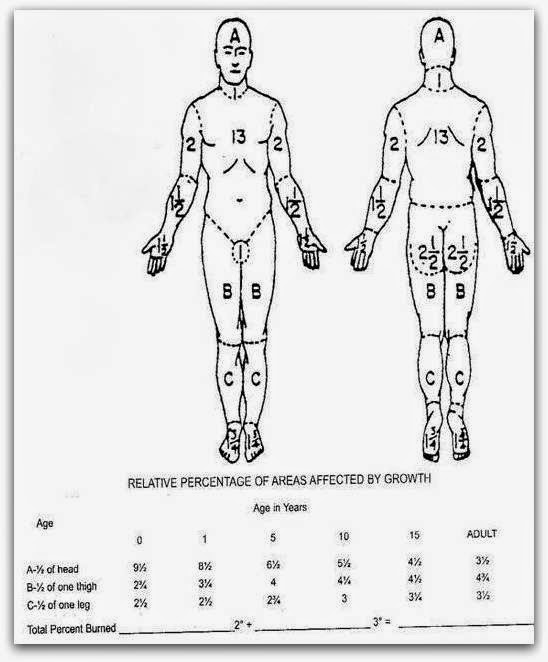
However in children the rule of nine
can lead to serious errors as the head and body is larger in TBSA than the
limbs and therefore the Lund and Browder charts work out to be
more accurate while calculating the fluids to be administered. The Lund and Browder chart is shown below.
If the fluid calculation is wrong
then the patient will be administered less fluids and this will result in shock
or low volume circulatory failure and ultimately may be fatal. The fluids calculated need to be replaced
within a time limit as we shall discuss in the next post. Correct volume replacement
and correct timing is what makes the resuscitation of burns patients
successful.
(an original initiative in burn care and education from
asktheburnsurgeon+)
Subscribe to:
Posts (Atom)
